


By Mark Joseph M. Sanchez and Pexcel John Bacon
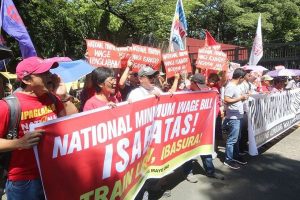
THE Trade Union Congress of the Philippines (TUCP) has asked a Pasig court to lift the temporary restraining order (TRO) against the implementation of Metro Manila’s minimum wage increase and dismiss the lawsuit filed by two construction firms challenging the wage order.
In a motion to intervene filed before the Regional Trial Court (RTC) Branch 152 on Tuesday, TUCP argued that the TRO issued against National Capital Region (NCR) Wage Order No. 27 violated Article 126 of the Labor Code, which prohibits courts from issuing injunctive relief against proceedings before the National Wages and Productivity Commission (NWPC) or regional wage boards.
“By enjoining the implementation of NCR Wage Order No. 27, the court has effectively restrained proceedings and actions arising from the wage determination process undertaken by the NCR-RTWPB (Regional Tripartite Wages and Productivity Board),” TUCP said.
The group also argued that petitioners Readycon Trading and Construction Corp. and R-II Builders, Inc. failed to establish a clear and unmistakable right that would justify injunctive relief.
TUCP said the P85 daily wage increase, which will be implemented in two tranches, represents a 12.23% adjustment and is lower than previous wage hikes in Metro Manila, citing increases of 19% in 1990 and 14% in 1993.
“Such disagreement does not create a judicially enforceable right to suspend the implementation of a duly issued wage order,” it said.
The labor group further argued that the continuing suspension of the wage increase causes greater harm to workers than to employers, estimating that about 1.1 million minimum wage earners in Metro Manila lose about P60 million in wages each day while the TRO remains in effect.
“Unlike petitioners’ alleged financial inconvenience, the injury suffered by workers is truly irreparable,” TUCP said.
It said the petition was premature because the companies had failed to first exhaust administrative remedies before seeking court intervention.
Under Republic Act No. 6727 or the Wage Rationalization Act, parties questioning a regional wage board’s decision on grounds such as legal error or grave abuse of discretion must first appeal before the NWPC, TUCP said.
The group asked the court to allow its intervention, admit its answer-in-intervention, dissolve the TRO, deny the application for a writ of preliminary injunction and dismiss the petition for lack of merit and failure to exhaust administrative remedies.
In an order dated July 30, Pasig RTC Branch 152 Judge Marie Joyce Manongsong granted the petition filed by the construction firms and halted the initial P60 daily minimum wage increase under Wage Order No. NCR-27.
The wage order also provides for a second P25 daily increase on Jan. 1, 2027, unless it is modified or overturned.
INTIMIDATED INTO ‘INACTION’Meanwhile, Party-list Rep. Democrito C. Mendoza urged key government agencies to defend the P85 daily wage increase and ensure that regional wage boards continue granting wage adjustments nationwide despite pending court challenges.
In House Resolution No. 1291, Mr. Mendoza called on the Department of Labor and Employment, Department of Trade and Industry, and Department of Economy, Planning and Development to defend the validity and implementation of the NCR wage order.
The resolution also urged all RTWPB to continue carrying out their mandate of periodically reviewing and increasing minimum wages across the country despite petitions questioning the Metro Manila wage order.
“We cannot allow a handful of employers to intimidate regional wage boards into inaction,” Mr. Mendoza said, warning that if the cases create fear among wage boards, future wage increases could become vulnerable to similar challenges.
Separately, Party-list Rep. Elijah “Eli” R. San Fernando filed five labor reform bills aimed at strengthening workers’ rights and addressing what he described as systemic workplace abuses.
Mr. San Fernando said the proposals were crafted from more than 20,000 complaints received through the group’s platform.
The package includes House Bill (HB) No. 10561 or the proposed Job Posting N’yo, Ayusin N’yo Act, which would require employers, recruitment agencies and online job platforms to disclose salary ranges, employment status, work locations and employer identities in job ads.
The bill will also prohibit deceptive recruitment practices and “ghost” job postings.
House Bill No. 10560 or the proposed Benepisyo Ko, Hulugan Mo Act seeks to impose stiffer penalties on employers that fail to pay or remit mandatory benefits, including Social Security System, PhilHealth, Pag-IBIG and 13th month pay contributions.
House Bill No. 10563 or the proposed Kontrata Ko, Ibigay Mo Act will require employers to provide workers with written employment contracts and timely access to employment records and certificates of employment.
The package also includes HB No. 10564, which would institutionalize mandatory labor-rights orientation for newly hired private-sector workers, and HB No. 10562, which seeks to extend the prescriptive period for filing labor-related money claims and unfair-labor-practice cases.
“Our proposed bills show the importance of bringing the voices of workers and ordinary Filipinos into Congress,” Mr. San Fernando said in Filipino.
The wage-order dispute comes alongside broader efforts in Congress to strengthen worker protections, as the court challenge raises questions about the implementation of wage increases and the authority of regional wage boards.