

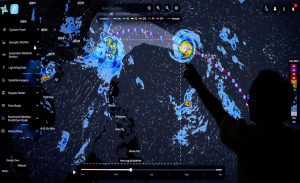

TYPHOON SAUDEL entered the Philippine area of responsibility (PAR) on Monday but was expected to stay far from the country and leave within 12 hours, as flooding from earlier storms and the southwest monsoon pushed 102 areas to declare a state of calamity.
Saudel, which was given the local name Obet after entering PAR, might slightly intensify but would remain a typhoon while inside the country’s monitoring zone, the state weather bureau said.
“Obet will continue moving generally west northwestward for the next two days before moving generally westward for the remaining forecast period,” the Philippine Atmospheric, Geophysical and Astronomical Services Administration (PAGASA) said in a 5 p.m. bulletin.
As of 4 p.m., Saudel was 1,430 kilometers east-northeast of Extreme Northern Luzon, packing maximum sustained winds of 165 kilometers per hour (kph) and gustiness of up to 205 kph. It was moving west-northwest at 30 kph, with typhoon-force winds extending up to 540 kilometers from its center.
No tropical cyclone wind signal was raised over the country.
PAGASA said Saudel would remain far from the Philippine landmass based on its forecast track. It was expected to weaken after leaving the Philippines as it moves toward southern Japan, north of Taiwan and southeastern mainland China, where it was forecast to make landfall.
The storm was expected to weaken into a severe tropical storm by Friday, Aug. 28, and into a tropical storm by Saturday, Aug. 29.
The southwest monsoon, however, will continue to bring strong to gale-force gusts over most of Luzon and the Visayas and parts of Mindanao through Wednesday.
The National Disaster Risk Reduction and Management Council (NDRRMC) said 102 local governments had declared a state of calamity as the country dealt with the combined effects of Tropical Cyclones Luis, Maymay and Neneng and the enhanced southwest monsoon.
The declarations covered 12 provinces and cities, including Dagupan, Pangasinan, Benguet, Bataan, Bulacan, Pampanga, Zambales, Rizal, Cavite, Batangas and Occidental Mindoro.
The NDRRMC reported 29 deaths, 19 injuries and three people missing. Benguet recorded 15 deaths, including 10 in Baguio, three in Atok, and two in La Trinidad, all due to landslides.
Rizal and Batangas each recorded four deaths. Other fatalities were reported in La Union, Quezon City, Oriental Mindoro, Negros Occidental and Caloocan.
About 7.5 million people from 2.2 million families across 10 regions had been affected, the agency said. The affected areas included the Ilocos Region, Cagayan Valley, Central Luzon, Bicol Region, Western Visayas, Zamboanga Peninsula, Calabarzon, Cordillera Administrative Region, Metro Manila and Mimaropa.
The NDRRMC said 418 evacuation centers were operating, sheltering 33,358 people from 9,858 families.
About 2,500 houses had been damaged, including 2,200 partially damaged and 285 totally damaged homes. Infrastructure losses reached P5.1 billion, while agricultural damage was estimated at P1.7 billion. Government assistance had reached P1.31 billion.
CLIMATE CHANGEPresident Ferdinand R. Marcos, Jr. said the severity of the flooding could not be attributed solely to deficiencies in government flood control projects, citing the intensity of the rainfall.
“This is the result of climate change,” he said after a situation briefing on the enhanced southwest monsoon in Central Luzon on Monday. “People need to understand that climate change is already here and we are being affected by it.”
Mr. Marcos also acknowledged that some flood control projects had not been completed.
“We know that many flood control projects, for example in Bulacan, were not done, which is why we are in this situation,” he said in Filipino.
The President said the government would first repair damaged infrastructure and assess areas that remained flooded before pursuing longer-term projects.
The government is considering five Sabo River dams in Nueva Ecija to slow water flowing from the Sierra Madre, reduce siltation and store water for household, industrial and agricultural use, Mr. Marcos said.
Authorities are also studying a roughly 100-kilometer road dike toward Pilar, Bataan, which he said could help block water coming from Manila Bay.
Pampanga was among the areas hardest hit by the enhanced southwest monsoon and the three tropical cyclones. The Presidential Communications Office said 1.01 million people from 315,807 families had been affected in the province.
About 11,308 people from 3,118 families remained in evacuation centers, including 559 families at 11 centers in Bacolor.
The Bacolor Integrated School evacuation center in Barangay Cabambangan was sheltering 216 families, or 836 people, as of Aug. 23. Some had remained there for 16 days.
The Department of Social Welfare and Development (DSWD) had distributed family food packs and hot meals and provided P10,000 in cash assistance to affected families.
The DSWD said P243.37 million in assistance had been provided to affected families in Pampanga. Its regional office had P2.63 million in standby funds and 127,947 family food packs available.
The Department of Public Works and Highways continued clearing drainage systems and waterways in Pampanga to help ease flooding.
PAGASA also warned of rough seas in several coastal areas, with waves reaching up to 3.5 meters along the Batanes seaboard and the northern seaboard of the Babuyan Islands.
Waves as high as 3 meters were expected along the western Babuyan Islands, northern Ilocos Norte and western Kalayaan Islands.
The weather bureau advised operators of motorboats and similarly sized vessels to take precautions and avoid sailing under such conditions when possible. — Norman P. Aquino and Erika Mae P. Sinaking