


By Erika Mae P. Sinaking, Reporter
VICE-PRESIDENT Sara Duterte-Carpio’s prospects for the 2028 presidential race will depend largely on whether her opponents can unite behind a single candidate, political analysts said, as a criminal case and an impeachment trial add uncertainty to her bid for Malacañang.
“Ultimately, her prospects depend on whether a unified anti-Duterte group can consolidate an adequate voter base constituted by remaining Marcos supporters, liberals, progressives and the still undecided,” Anthony Lawrence A. Borja, an associate political science professor at De La Salle University, told BusinessWorld in a Facebook Messenger chat.
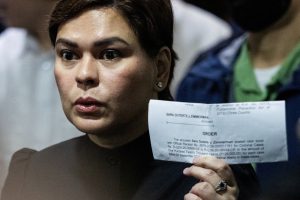
The Quezon City Regional Trial Court Branch 98 last week issued a warrant of arrest for Ms. Duterte over three counts of grave threats, with bail set at P120,000 per count. The court also denied her motion to defer or recall the warrant and quash the charges, finding probable cause to hold her for trial.
Ms. Duterte posted P360,000 in bail for the three counts on Saturday.
The case stemmed from a 2024 press briefing in which she said she had instructed someone to kill President Ferdinand R. Marcos, Jr., First Lady Maria Louise “Liza” Araneta-Marcos and then-Speaker Ferdinand Martin G. Romualdez should she herself be killed.
Mr. Borja said the criminal case would “certainly solidify her core of supporters,” but added that Ms. Duterte’s prospects would ultimately depend on whether her opponents can consolidate enough voters.
Froilan C. Calilung, a political science professor at the University of Santo Tomas, said the grave threats case and impeachment proceedings could further shape public perceptions of Ms. Duterte.
He said the cases appeared aimed at portraying the Vice-President as a villain after her popularity remained strong despite the impeachment proceedings.
Ms. Duterte is facing an impeachment trial in the Senate, which began on July 6 after the House of Representatives impeached her on May 11 on charges of betrayal of public trust, culpable violation of the Constitution, graft and corruption and bribery.
A conviction by at least two-thirds of the Senate, sitting as an impeachment court, would remove her from office and permanently bar her from seeking elective office, including the presidency in 2028.
A Social Weather Stations survey conducted in the second quarter showed Ms. Duterte with a 57% trust rating, compared with Mr. Marcos’ 34%.
Mr. Calilung said Ms. Duterte’s ratings have risen as the President’s have declined, an outcome he said the administration “were not really expecting.”
“All of these cases will definitely wear down the Vice-President mentally and emotionally,” he said via Viber. The pressure could potentially force Ms. Duterte to reconsider entering the presidential race, he added.
The grave threats case does not automatically prevent Ms. Duterte from running for President, former Commission on Elections (Comelec) Commissioner Luie Tito F. Guia said.
“Conviction is necessary because that is when a person really becomes a disqualified criminal,” he told BusinessWorld via Messenger. He said not every criminal conviction carries a penalty of disqualification from public office.
“Only when the crime is punishable by said disqualification can disqualification set in,” he said, adding that Congress, not the Comelec, determines which offenses carry disqualification as a penalty.
Former chief presidential legal counsel Salvador S. Panelo, meanwhile, said the Quezon City court erred in denying Ms. Duterte’s motion to quash the arrest warrant, arguing that presidential immunity from suit should extend to the Vice-President.
“The Vice-President has duties to perform too, and like the President should not be bothered by suits that will diminish her focus on her official work,” he said via Viber.
He also argued that because grave threats are among the allegations in the impeachment case, the trial court should dismiss the criminal case or suspend its proceedings.
“The Department of Justice’s (DoJ) position is that presidential immunity is lodged solely in the President as chief executive, which is why the DoJ filed the case against the accused,” Justice spokesman Raphael Niccolo L. Martinez told reporters on Friday.
Mr. Panelo also said public discontent over what he called “failed governance” and corruption under the Marcos administration would boost support for Ms. Duterte, potentially making the 2028 election a foregone conclusion.
The House prosecution panel has said it aims to complete its presentation of evidence by mid-October, while the defense is expected to finish its case by November. The Senate impeachment court could reach a verdict before yearend.
Ms. Duterte announced her presidential candidacy for the 2028 elections on Feb. 18.