

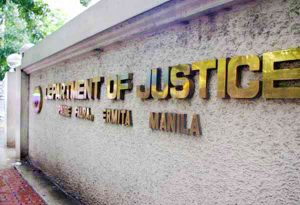

CONGRESSMEN are pushing to restore proposed cuts to the Department of Justice’s (DoJ) 2027 budget, warning that lower funding for anti-trafficking, cybercrime and child protection programs could slow rescue operations and the government’s response to online sexual abuse.
Party-list Rep. Sarah Jane I. Elago questioned the reductions during a House of Representatives Committee on Appropriations hearing on Monday, particularly those affecting the DoJ’s Special Enforcement and Protection sub-program.
“We in Gabriela Women’s Party likewise express grave concern over the proposed massive budget cuts in the budget of the Special Enforcement and Protection sub-program, particularly in the anti-trafficking persons enforcement, anti-cybercrime enforcement, as well as the NCC,” she said, referring to the National Coordination Center for online sexual abuse or exploitation of children.
Justice Assistant Secretary Michelle Anne S. Lapuz said the center’s budget would fall to P35.6 million under the 2027 National Expenditure Program from P111.5 million in 2026. The DoJ is seeking an additional P75.9 million to restore the allocation to its 2026 level.
The Inter-Agency Council Against Trafficking Secretariat will receive P70 million, down from P119 million, with the department seeking an additional P49 million.
The Office of Cybercrime faces a 90% cut, with its allocation falling to P12.273 million from P102.2 million, Ms. Lapuz said.
Ms. Elago asked for the original 2027 proposals for the affected programs, saying the cuts were deeper than previously discussed.
Ms. Lapuz said the units still needed funding at 2026 levels but faced constraints from their absorptive capacity, procurement capabilities and plantilla positions.
Party-list Rep. Percival P. Cendaña asked what cuts ranging from 14% to 71% would mean for the government’s ability to respond to trafficking and online child abuse cases.
“First of all, it will slow down the national response against online sexual abuse or exploitation of children and trafficking,” Ms. Lapuz said in Filipino.
Local task forces have mechanisms to respond to cases but lack sufficient resources, while responses remain fragmented, she said.
“If we don’t have enough resources to support the operations of these mechanisms, rescue operations would slow,” she said in mixed English and Filipino.
Mr. Cendaña said the proposed allocations could effectively make victim rescue less of a priority.
“This means that we are saying it is okay for the government not to rescue the victims and for the process of ensuring their safety to be slowed down,” he said in Filipino.
Rep. Jan Rurik “JP” D. Padiernos backed a higher DoJ allocation, particularly for the National Bureau of Investigation (NBI) and Bureau of Immigration, whose proposed budgets would fall 33% and 27%, respectively.
Justice Secretary Fredderick A. Vida attributed the reductions to the agencies’ assessed ability to spend their allocations.
The DoJ’s recommended 2027 budget is P46.435 billion, slightly higher than its P45.525-billion allocation in 2026. The amount represents 0.64% of the total budget.
The department-wide proposal was P121.63 billion, indicating that most of the agency’s requested funding was not included in the recommended allocation.
Several attached agencies face lower allocations, including the Bureau of Immigration, NBI, Office of the Government Corporate Counsel and Office of Alternative Dispute Resolution.
The Bureau of Corrections (BuCor), Land Registration Authority, Office of the Solicitor General, Presidential Commission on Good Government, and Public Attorney’s Office were recommended higher allocations.
BuCor is seeking P11.93 billion in 2027, up 9.66% from P10.88 billion this year, to fund prison operations, personnel, facilities and the transfer of prisoners.
BuCor Director General Gregorio Pio P. Catapang, Jr. said the proposed allocation would also support prison security and the modernization of correctional operations. The bureau houses 52,356 inmates in facilities designed for 17,211, resulting in a 204% congestion rate.
The DoJ said 68.32% of its recommended 2027 budget would go to personal services, 24.42% to maintenance and other operating expenses and 7.26% to capital outlays. — MJMS