

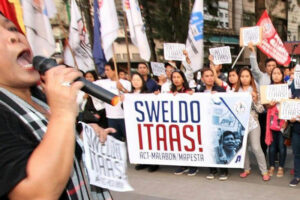

TWENTY-ONE senators have urged a Pasig court to lift the temporary restraining order (TRO) blocking the implementation of the P85 daily minimum wage increase in Metro Manila, warning that the case could undermine the country’s wage-setting system and delay future pay adjustments.
Senate Majority Leader Juan Miguel F. Zubiri gathered the signatures for Senate Resolution No. 577, dated Aug. 4, which appealed to Regional Trial Court (RTC) Branch 152 to immediately lift the TRO against Wage Order No. NCR-27.
“Otherwise, it would set a bad precedent because if a P30 increase is approved in Cagayan de Oro or Northern Mindanao, anyone could just go to a friendly court and seek a restraining order,” Mr. Zubiri said in a statement.
The resolution cited Article 126 of the Labor Code, which prohibits courts and other entities from issuing injunctive relief against proceedings and decisions of the National Wages and Productivity Commission (NWPC) and regional wage boards.
“We respectfully but firmly appeal to Branch 152 to lift the TRO immediately,” Mr. Zubiri said. “Allow the wage-setting system created by law to work and let our workers receive the relief already granted to them.”
The Regional Tripartite Wages and Productivity Board-National Capital Region (RTWPB-NCR) approved the P85 daily minimum wage increase in June, with the adjustment initially scheduled to take effect on July 25.
The wage order provides for a staggered increase, with P60 to be granted under the first tranche and the remaining P25 to take effect on Jan. 20, 2027.
However, Pasig RTC Branch 152 issued a TRO on July 30 suspending the increase following a lawsuit filed by construction firms questioning the wage increase.
The senators said the court action could have implications beyond Metro Manila by creating uncertainty over the authority of regional wage boards to determine and implement minimum wage adjustments.
The resolution also echoed calls from labor groups to lift the TRO, emphasizing workers’ entitlement to a “decent and dignified” wage.
Senator Rafael “Raffy” T. Tulfo separately filed Senate Bill No. 2372 on Monday seeking to amend Article 126 of the Labor Code to explicitly prohibit courts from issuing TROs against wage orders or resolutions issued by the NWPC and regional wage boards.
Under the proposed amendment, any injunction or restraining order issued in violation of the provision would be declared void.
The bill also requires parties challenging a wage order to pursue the administrative appellate processes provided under the Labor Code instead of seeking judicial intervention.
“Any such injunction or restraining order issued in violation of this provision shall be null and void ab initio,” according to a copy of the bill. “The exclusive remedy for any party aggrieved by a wage order shall be through the administrative appellate processes provided under this code.”
Labor Secretary Francis N. Tolentino welcomed the Senate’s support for the wage increase and said the Department of Labor and Employment would continue defending the validity of the wage order.
“We are the ones proving that the process was right, that the P60 and P25 granted were correct,” he said in a statement. “The whole process was in accordance with the Labor Code of the Philippines.”
‘PRECEDENT TO WEAPONIZE TROS’Meanwhile, Party-list Rep. Percival “Perci” V. Cendaña separately called on the Pasig court to lift the TRO, warning that its continued enforcement could set a precedent for using court injunctions to block future wage increases.
He said he joined labor leaders and workers in filing a motion to intervene before the court, arguing that the wage-setting process established under law should be allowed to proceed.
“It is urgent that we lift this injunction or else this becomes a precedent to weaponize TROs against any and all wage increases in the country,” he said.
Mr. Cendaña said Article 126 clearly bars courts from issuing TROs against wage orders and argued that challenges should instead be brought through the administrative mechanisms provided under the wage-setting system.
“It is clear under Article 126 of the Labor Code that a TRO cannot be issued against a wage order,” he said in Filipino. “There is no room for interpretation on this matter.”
The lawmaker also urged the Supreme Court to examine judges who continue to issue orders blocking wage adjustments, noting the high court’s administrative supervision over lower courts.
The motion to intervene was filed together with Metro Manila minimum wage workers and labor organizations, including the National Union of Workers in Hotel, Restaurant and Allied Industries, Alliance of Filipino Workers, Workers Solidarity Network, and the Labor Education and Research Network.
Akbayan Party-list has also filed House Resolution No. 1273 seeking a congressional inquiry into the legal and practical implications of the TRO and its potential impact on the country’s wage-setting mechanism.
The groups supporting the wage increase said the dispute is not only about the P85 adjustment in Metro Manila but also about preserving the authority of regional wage boards to review minimum wages and provide workers with adjustments based on prevailing economic conditions. — Kaela Patricia B. Gabriel and Pexcel John Bacon