


By Kaela Patricia B. Gabriel and Erika Mae P. Sinaking,Reporter
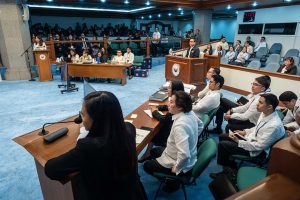
THE Senate impeachment court on Wednesday ordered prosecutors, defense lawyers and senator-judges to refrain from publicly discussing the merits of Vice-President Sara Duterte-Carpio’s impeachment case, warning that violations could result in reprimands and fines as proceedings entered their third week.
“Counsel of record must litigate their respective causes before this court, not in the court of public opinion through interviews, social media posts or publicity generated, authorized, encouraged, or disseminated through surrogates,” Presiding Senator-Judge Francis Joseph G. Escudero said during the trial’s 19th day.
He said the restriction applies to members of the House of Representatives prosecution panel, the Vice-President’s defense team and senator-judges participating in the proceedings. He also reminded senator-judges to comply with Rule 18 of the Senate impeachment rules, which governs public comments and disclosures related to pending impeachment trials.
“Since Rule 18 directly governs public comments and disclosures pertaining to the merits of a pending impeachment trial, it is for this court, in the exercise of its authority and sound discretion, to determine whether a particular statement violates that rule,” he said.
The impeachment court said stricter enforcement of Rule 18 began on Aug. 26. The rule seeks to prevent trial by publicity and bars parties from presenting arguments and evidence through media platforms rather than before the court.
Under the court’s ruling, a first violation will result in a public reprimand and admonition. A second violation will carry a P30,000 fine.
“Each subsequent violation of Rule 18 shall be punished the same way as a second offense, a fine of P30,000,” Mr. Escudero said.
The ruling came more than a week after defense lawyer Sheila C. Sison raised concerns over a Facebook post by House private prosecutor Amando Virgil D. Ligutan discussing misleading questions during cross-examinations.
Mr. Ligutan defended his post, saying it was intended to correct a legal point raised in open court and was not directed at the merits of the impeachment case.
“It is not personal,” he said. “It is about the law that we all adhere to. It is about what we teach the public who are watching our trial,” he said.
“Correcting a mistake is never wrong. I did not discuss the merits of the case. I did not discuss the strength or weakness of the legal arguments or evidence of either side.”
Mr. Escudero said the ruling was not solely a response to the Aug. 12 manifestation involving Mr. Ligutan but was also based on other apparent violations of Rule 18 observed during the proceedings.
Political analysts said the measure should not be interpreted as a news blackout but as an effort to protect due process and ensure that evidence is tested inside the impeachment court.
Hansley A. Juliano, a political science instructor at the Ateneo de Manila University, said limits on public discussion of sensitive issues are common in legal proceedings.
“It need not be seen as blackout unless the process is actively preventing admission of evidence or testimonies,” he said in a Facebook Messenger chat. “Keep the discussion of relevant points in the trial itself, and avoid spilling each side’s beans.”
He added that attempts to shape public opinion through media exposure could undermine the proceedings.
“If certain camps use media exposure to spin the trial as biased against them, it runs against the interest of the trial and are grounds for contempt,” he said.
Paul Micah S.A. Francisco, a political science instructor at the University of Santo Tomas, said the ruling could help avoid multiple interpretations of the case and limit trial by publicity.
“I understand the public interest in the trial,” he said via Messenger. “However, the merits of the case must be discussed in the proper forum.”
“That proper forum is the impeachment court. Anything outside that can be considered propaganda or misdirection,” he added.
He said comments made outside the courtroom could be used to influence public opinion and shape narratives surrounding the case.
‘WEAK PRESENTATION’Meanwhile, Ms. Duterte rejected characterizations made during recent hearings, saying insults and speculation do not constitute proof of an impeachable offense.
“A senator calling a witness ‘stupid,’ a lawyer calling me the ‘mastermind of a scam’ or another witness referring to me as a ‘brat,’ does not prove a case, nor does it produce evidence,” she said in a statement. “Insults reveal the need to feign confidence in the face of a weak presentation.”
Her remarks followed confrontations during recent trial sessions.
During Monday’s hearing, Senator-Judge Rafael “Raffy” T. Tulfo criticized Office of the Vice-President (OVP) Special Disbursing Officer Gina F. Acosta over alleged discrepancies in acknowledgment receipts tied to confidential funds, calling her “stupid in the name of blind loyalty.”
On Tuesday, private prosecutor Mae S. Divinagracia referred to Ms. Duterte as the “mastermind of a scam” during her direct examination of OVP Assistant Chief of Staff Lemuel G. Ortonio. Mr. Escudero later ordered the statement stricken from the record.
Ms. Duterte also accused the Marcos administration and its allies of prioritizing impeachment proceedings, discussions on the 2027 budget and preparations for Charter change instead of addressing flooding and poverty.
At a Palace briefing, Press Officer Clarissa A. Castro rejected that criticism and said testimony presented during the impeachment trial provided evidence about Ms. Duterte’s knowledge of transactions involving OVP confidential funds.
“Other evidence was further demonstrated showing that the Vice-President was the one who had knowledge, from the withdrawal of funds, to the spending, up to the submission of the report,” Ms. Castro said, citing testimony from Mr. Ortonio.
She said the government does not condone personal attacks but added that public officials should also avoid derogatory language.
On the use of the terms “mastermind” and “scam,” Ms. Castro said such labels should not be attached to individuals before a final ruling is issued.
“It is difficult to say mastermind or scam about a particular person while there is no concrete decision yet,” she said.
Ms. Castro also disputed Ms. Duterte’s claim that the administration was neglecting flood control concerns. She cited directives from President Ferdinand R. Marcos, Jr. to address flooding in Davao City and review projects that officials said remained unfinished.
The Palace official added that the Office of the Ombudsman is expected to investigate spending on flood control projects in Davao City and determine whether projects reported as completed were actually implemented.