

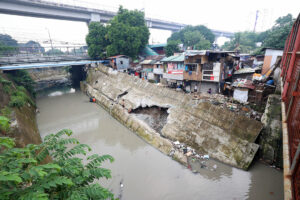

PRESIDENT Ferdinand R. Marcos, Jr. ordered government agencies and local government units (LGU) to strictly enforce climate-related regulations, including no-build zones, as heavy rains and flooding continue to affect parts of the country.
“According to the President, laws should be enforced, including the ‘no-build zone,’” Palace Press Officer Clarissa A. Castro told reporters on Tuesday in Filipino, citing discussions during a Cabinet meeting on Monday. “Let us stop politicizing it, enforce the law, and it should be explained to everyone that the implementation of the law needs to be stricter for our safety.”
Mr. Marcos directed LGUs to enforce no-build zones, clear obstructions in waterways, maintain drainage systems and ensure proper garbage disposal, Ms. Castro said.
The President said laws have not always been enforced because of political connections and corruption. He also called for climate change awareness to be incorporated in public education to help communities prepare for severe weather.
Ms. Castro said Mr. Marcos cited unimplemented master plans for Metro Manila and Cebu dating back to 1941 and 1936, respectively. Had those plans been carried out, some areas might have remained open spaces capable of absorbing rainwater, she said.
The Palace did not identify officials who might be held accountable for the failure to implement the plans.
“For now, we will not say who is to blame. We need to find a solution so that the waterways and drainage systems can be properly implemented and fixed,” Ms. Castro said.
The Department of Public Works and Highways is focused on repairing flood-damaged roads, bridges and dikes while pursuing measures to reduce the impact of heavy rainfall and rising floodwaters, she said.
Ms. Castro said stricter enforcement of no-build zones could displace residents living in prohibited areas but said safe relocation sites should be provided.
“Naturally, some of our fellow citizens who might be displaced from their usual homes will feel aggrieved, but we must enforce the law and simply provide them with a place where they can live safely because lives could be lost,” she said.
Mr. Marcos also ordered agencies to review whether existing flood control measures remain adequate, taking into account changes in rainfall patterns over the past decade.
Ms. Castro said the Palace would coordinate with the Climate Change Commission following concerns that some agencies had been slow to adopt its policies.
“That will no longer happen because the issue of climate change will be given attention,” Ms. Castro said.
The government continues to monitor weather disturbances in and around the Philippine area of responsibility (PAR).
The Philippine Atmospheric, Geophysical and Astronomical Services Administration said Tropical Storm Pilandok remained inside the country’s monitoring area as of Tuesday, while Tropical Storm Saudel and another low-pressure area were being tracked outside PAR.
The Department of Social Welfare and Development has provided more than P618.3 million in assistance to flood-hit areas in Tarlac, Pampanga and Bulacan, while total aid distributed in Central Luzon exceeded P874.8 million, Ms. Castro said.
The Department of Agriculture is also providing affected farmers and fisherfolk with crop insurance, farm assistance and loans of as much as P35,000 under government recovery programs. — Erika Mae P. Sinaking