

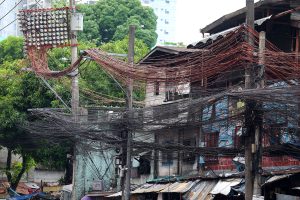

THE Department of Energy (DoE) on Thursday reaffirmed its support for President Ferdinand R. Marcos, Jr.’s directive to remove system loss charges from consumers’ electricity bills, saying it is prepared to work with other government agencies to reduce electricity losses through improved infrastructure, better collection efficiency and assistance to distribution utilities.
“We support the directive of the President,” Energy Undersecretary Riolita C. Inocencio told a Senate Energy Committee hearing on proposed changes to the Electric Power Industry Reform Act (EPIRA).
She said the department would work with the National Electrification Administration (NEA) in determining the appropriate level of recoverable technical system losses while exploring additional measures to help electric cooperatives and distribution utilities improve their systems and minimize losses.
The hearing centered on Mr. Marcos’ proposal, announced during his fifth State of the Nation Address (SONA) on Monday, to prohibit power companies from passing system loss charges on to consumers.
Senator Erwin T. Tulfo, who heads the committee, questioned why electricity consumers continue to shoulder costs arising from nontechnical losses, including electricity pilferage, illegal connections, meter tampering and jumpers.
“Why are we allowing these electric pilferages to be charged to consumers?” he asked in mixed English and Filipino. “I understand the technical losses. But how about the nontechnical?”
“Maybe let’s prioritize the nontechnical ones first — pilferage, illegal metering, and tampering. Let us not charge our citizens for those, including the VAT (value-added tax),” he added.
Energy Regulatory Commission (ERC) Chairman and Chief Executive Officer Francis Saturnino C. Juan said Republic Act No. 7832 or the Anti-Electricity and Electric Transmission Lines/Materials Pilferage Act already provides the legal framework governing recoverable nontechnical losses.
“The purpose of having a cap, and lowering that cap over time, is to bring down the costs related to pilferage,” Mr. Juan said. “Under that law and the policy contained in that law, it is allowed. This is a legitimate cost, but subject to a limit.”
He said the existing system loss cap was meant to encourage distribution utilities to continuously reduce losses while preventing them from passing unlimited costs on to consumers.
Senate President Sherwin T. Gatchalian proposed that system losses should instead be absorbed by distribution utilities, arguing that doing so would encourage companies to improve operational efficiency and boost anti-pilferage measures.
“The answer, obviously, is the distribution company,” Mr. Gatchalian said. “It will become part of their operating cost in distributing electricity. The benefit is that distribution utilities will be forced to become more efficient.”
He also urged authorities to intensify enforcement against electricity theft, saying illegal connections and other forms of pilferage should be addressed through law enforcement rather than recovered from paying consumers.
The Senate is hearing several measures seeking to amend EPIRA, including proposals to prohibit the recovery of system loss charges from consumers and strengthen the powers of the ERC.
Following Mr. Marcos’ SONA, Mr. Tulfo said his committee would prioritize deliberations on the proposed EPIRA amendments and aims to complete work on the measures before the end of the year.
He said the committee intends to address the President’s call to lower electricity costs by reviewing the existing framework governing system loss charges and related provisions under the country’s power reform law.
Meanwhile, Malacañang is seeking multi-stakeholder consultations after energy sector leaders raised concerns over the President’s proposal.
“We are studying the regulations and doing consultations,” Palace Press Officer Clarissa A. Castro, told a news briefing, citing Energy Secretary Sharon S. Garin.
Manuel V. Pangilinan, chairman and chief executive officer of Manila Electric Co., warned that the proposal affects the entire industry, noting the cost is too high to absorb.
Ms. Castro said the government would balance consumer relief with the stability of energy distributors and investors. — Kaela Patricia B. Gabriel and Erika Mae P. Sinaking