

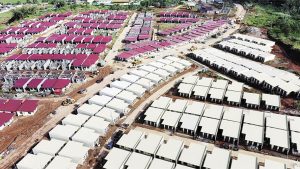
THE Department of Human Settlements and Urban Development (DHSUD) is appealing to Congress for a P16-billion budget augmentation for 2027, seeking to bridge a P54-billion gap between its initial proposal and the lower ceiling set under the National Expenditure Program (NEP).
DHSUD Undersecretary Henry L. Yap highlighted the severe disparity between the sector’s operational requirements and the executive branch’s outlay.
“This year, vis-a-vis its proposal, we actually proposed altogether P60 billion, but the variance is about P54 billion,” Mr. Yap said during the Senate hearing for DHSUD’s proposed 2027 budget on Tuesday.
To keep vital housing projects and financial programs operational, the department and its key shelter agencies requested an additional P16 billion in supplementary funding. Under the proposed NEP ceiling, the main DHSUD office was allocated P2.49 billion against an original request of P4.96 billion.
The funding cuts heavily impacted attached shelter corporations responsible for frontline housing construction and financing.
The Social Housing Finance Corp. (SHFC) was granted P166 million compared to its original request of P4.6 billion. The National Housing Authority was allocated P2.27 billion against its initial P44.73-billion proposal while seeking P3.26 billion for nationwide resettlement projects. The National Home Mortgage Finance Corp. received P450,000 under the NEP despite requesting P4.7 billion.
Meanwhile, the Home Development Mutual Fund (Pag-IBIG Fund) operates without direct NEP subsidy, drawing from its 16.79 million active members to support affordable housing through reduced social interest rates and allocating P4.08 billion across 15 housing projects under the Pambansang Pabahay para sa Pilipino (4PH) program.
Senate Committee on Urban Planning, Housing and Resettlement Chair Senator Joseph Victor G. Ejercito pressed officials on whether existing appropriations are sufficient to tackle the country’s massive housing backlog, which estimates place at over 3.7 million units.
DHSUD Secretary Jose Ramon P. Aliling explained that the department reshaped the flagship 4PH program to adapt to market demands and varying income levels. Initially limited to high-cost vertical condominiums, the 4PH program has been broadened to cover house-and-lot developments, rental housing, and community mortgage initiatives.
“The traction [on] the ground was not that good. So, what we did to improve this is, we expanded the 4PH because we saw that the housing program is demand-driven,” Mr. Aliling said.
“At first, 1,000 took out the vertical modality. Now, those who qualified in 4PH is around 135,000… Whatever they can afford, we have the right housing program.”
Under the Community Mortgage Program managed by SHFC, monthly amortizations for low-income informal settler families start as low as P600 per month. For disaster-prone areas, DHSUD also introduced Bayanihan Villages which are temporary modular shelter units deployed across local government unit properties in typhoon and earthquake-affected provinces. — Juliana Chloe A. Gonzales