


By Mark Joseph M. Sanchez and Erika Mae P. Sinaking, Reporter
PRESIDENT Ferdinand R. Marcos, Jr.’s declaration that even members of his own family would not be spared from corruption investigations has raised the political stakes for his administration’s anti-graft campaign, with analysts saying its credibility will depend not only on whether cases are pursued impartially but also on whether the government delivers on the broader reform agenda it outlined for the remainder of its term.
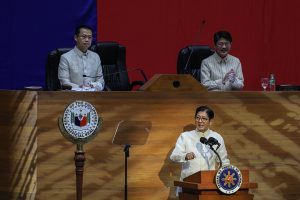
In his fifth State of the Nation Address (SONA) on Monday, Mr. Marcos said multiple cases involving former Speaker and Leyte Rep. Ferdinand Martin G. Romualdez, his first cousin, were nearing filing, citing information from the Office of the Ombudsman.
“Painful as this is for me, we have to do what is right,” he said in Filipino. “I am not the President of my family. I am not the President of my friends. I am the President of the Philippines, and my duty is to you: my fellow Filipinos.”
The remarks came as the Ombudsman continued its investigation into anomalies involving the government’s flood control program.
On Tuesday, Assistant Ombudsman Jose Dominic “Mico” F. Clavano IV confirmed that Mr. Romualdez and the other respondents had been ordered to submit their counter-affidavits within 15 days after the preliminary investigation panel found sufficient basis to require them to answer the complaints.
Once all parties have submitted the pleadings, the case will be submitted for resolution, he said.
The cases stem from a supplemental complaint recommending the filing of plunder, graft, bribery and anti-money laundering charges over the alleged diversion of about P56 billion in public funds from 2022 to 2025. The preliminary investigation continues, and no criminal charges have been filed before the courts.
Ederson DT. Tapia, a political science professor at the University of Makati, said the President’s statement was significant because it sought to demonstrate that personal and family relationships would not take precedence over public accountability.
“With cases reportedly nearing filing against former Speaker Martin Romualdez, his cousin and erstwhile principal political ally, the administration is presenting this as evidence that its anti-corruption campaign will reach even those closest to the President,” he said via Facebook Messenger.
He added that the campaign would ultimately be judged by the integrity of the legal process.
‘CONVENIENT SCAPEGOAT’“The campaign’s credibility will depend on whether the cases are supported by evidence, pursued consistently and allowed to proceed without interference,” Mr. Tapia said. “Due process must be observed. Otherwise, the action could be interpreted either as political distancing or an attempt to find a convenient scapegoat.”
“The real test is not the strength of the declaration, but whether accountability is impartial, institutional and sustained, regardless of the political position or relationship of those implicated,” he added.
Jean Encinas-Franco, a political science professor at the University of the Philippines Diliman, said the President’s remarks appeared intended to reinforce the administration’s commitment to addressing irregularities in flood control spending, an issue that has drawn intense public scrutiny following reports of questionable infrastructure projects.
“The President wants to be perceived as serious in addressing the flood control scandal,” she said. “He knows that this would resonate with the people.”
Still, she said rhetoric would not be enough.
“We need to see if this will become a reality,” Ms. Encinas-Franco said. “If indeed it does, it could become a significant part of the legacy he will leave at the end of his term. But we have to wait and see and continue pushing for this to happen.”
The Ombudsman has likewise stressed that the investigation would proceed independently.
Following the President’s SONA, the anti-graft body said it would continue carrying out its constitutional mandate “without fear or favor,” adding that it remains committed to following the evidence wherever it leads, including to those closest to the President.
Beyond the corruption probe, analysts said the administration must also demonstrate that it could translate the policy agenda outlined in the SONA into concrete reforms during its remaining two years in office.
“Right now, Mr. Marcos and the two houses of Congress are under pressure to deliver in legislation and policy reform what they currently lack in credibility and populist charisma,” Hansley A. Juliano, a political science lecturer at the Ateneo de Manila University, told BusinessWorld via Facebook Messenger.
He said many of the President’s proposals, including tax relief, social safety nets and West Philippine Sea initiatives, are politically popular, but other priorities could undermine the administration’s message of independence.
“The administration has to decide whether to stick with the technocratic status quo or pursue a more genuinely consultative approach to policymaking,” Mr. Juliano said. “Two years is enough to bring in greater civil society and sectoral integration. Two years is not enough to juggle multiple balls.”
Anthony Lawrence A. Borja, an associate political science professor at De La Salle University, said the President’s emphasis on welfare measures reflects an effort to maintain political momentum in the final two years of his term.
“Marcos does not want to rock the boat politically and appear like a lame duck,” he said in a Messenger chat.
He said proposals such as tax relief for middle-income earners and small businesses, lower electricity costs and expanded social assistance are likely to gain support in Congress because they directly benefit voters.
“They will probably pass measures that can perpetuate clientelism among Filipinos, that is, welfare policies that can reach the local level and make recipients beholden to the government,” Mr. Borja said. “These are vote-generating policies even if they are fiscally expensive.”
Mr. Borja also noted that the President did not mention politically contentious measures such as the proposed anti-political dynasty law, suggesting that more difficult governance reforms have become less of a priority.
Mr. Juliano said the success of the administration’s legislative agenda ultimately depends on implementation rather than promises.
“Of course, that is assuming enough people benefit and corruption does not worsen,” he said. “That is easier said than done.”