

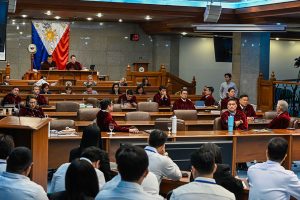
THE Supreme Court (SC) dismissed three petitions challenging the Senate impeachment court’s interpretation of a two-thirds vote required to convict in an impeachment case, citing a lack of standing and prematurity.
The three petitions were filed by Victor D. Rodriguez, Berteni Cataluña Causing, and Ernesto B. Francisco, Jr. in relation to the ongoing impeachment trial of Vice-President Sara Duterte-Carpio in the Senate.
The SC noted that the Senate impeachment court ruled that the phrase “all members of the Senate” under Article XI, Section 3(6) of the Constitution only refers to senators who are legally and actually able to participate in the impeachment proceedings at the time of the vote.
In his petition, Mr. Rodriguez argued that the impeachment court amended the Constitution by adding a qualification not found in its text and asked the SC to nullify the ruling and declare that any change to Article XI, Section 3(6) must go through the constitutional process for amendment or revision.
Meanwhile, Mr. Causing argued in his petition that Senators who remain in office should still be counted even if they are hiding, detained, or medically unable to attend, seeking to compel Senators Jose “Jinggoy” P. Ejercito Estrada, Jr., Rodante D. Marcoleta, and Ronald M. dela Rosa to participate in the impeachment trial and for the Senate to take the necessary steps to secure their attendance.
Similarly, Mr. Francisco argued that because the Constitution provides for a 24-member Senate, conviction requires the approval of at least 16 senator-judges, maintaining that those who are detained, on medical leave, or temporarily absent remain as members of the Senate and should be counted.
Mr. Rodriguez sought a temporary restraining order (TRO), while Mr. Francisco asked for a status quo ante order (SQAO). Mr. Causing prayed for the issuance of both an SQAO and/or a TRO.
Meanwhile, the SC also directed the respondents of a petition filed by election lawyer Romulo B. Macalintal, including the Office of the President, the Senate, the House of Representatives, and the Commission on Elections, to comment on the petition, which challenged the constitutionality of Republic Act (RA) No. 12326.
RA No. 12326 gave barangay officials and members of the Sangguniang Kabataan (SK) nationwide a five-year fixed term. It also postponed the upcoming Barangay and Sangguniang Kabataan Elections (BSKE) to November 2028 from its original schedule of November this year.
Mr. Macalintal argues that the new law violates the public’s right to vote by postponing the 2026 BSKE under the pretense of fixing the officials’ term of office, claiming that it effectively allows incumbent barangay and SK officials to hold over their positions for three more years. — Marron Joshua F. Mendoza