

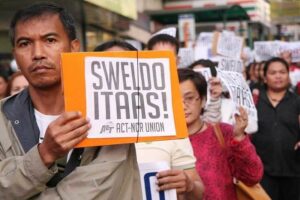

SEVERAL labor groups asked a Pasig court on Monday to let them intervene in the case challenging the P85 daily minimum wage increase for Metro Manila workers, arguing that the temporary restraining order (TRO) suspending its implementation directly deprives workers of wages already granted under the wage order.
In an urgent motion before Pasig Regional Trial Court Branch 152, the Federation of Free Workers, Sentro ng mga Nagkakaisa at Progresibong Manggagawa (SENTRO), Partido Manggagawa and other labor organizations sought leave to intervene and asked the court to lift the TRO and earlier status quo ante order against Wage Order No. NCR-27.
The groups said they have a “direct, actual and material legal interest” in the case because they represent workers who are the intended beneficiaries of the wage increase.
“We, the intervenors, have a direct, actual and material legal interest because we represent workers who are the immediate beneficiaries of the NCR Wage Order, whose wage increase is being withheld by the TRO,” SENTRO Secretary-General Josua T. Mata said in a Viber message.
The labor groups also asked the court to dismiss the petition filed by Readycon Trading and Construction Corp. and R-II Builders, Inc., arguing that regional trial courts have no jurisdiction over disputes involving wage orders.
They said Republic Act No. 6727 or the Wage Rationalization Act requires parties questioning wage orders to first appeal before the National Wages and Productivity Commission, while Article 126 of the Labor Code bars courts from issuing injunctions or TROs against proceedings of regional wage boards.
The motion also argued that the P85 increase remains “far from a living wage,” noting that even after its full implementation, the P780 daily minimum wage in Metro Manila would still be below the estimated family living wage.
In a separate statement, labor coalition NAGKAISA urged the immediate lifting of the TRO, saying it continues to deprive workers of the approved wage increase.
“Every day the TRO remains in force is another day millions of minimum wage earners are denied even this modest wage increase,” NAGKAISA spokesman Rene Magtubo said. “Workers need leadership, not silence.”
The case challenges Wage Order No. NCR-27, which grants an P85 daily minimum wage increase for private-sector workers in Metro Manila in two tranches. The TRO suspended the initial P60 increase that was scheduled to take effect on July 25, while the remaining P25 tranche is due on Jan. 20, 2027, unless the wage order is modified or overturned.
‘ECONOMIC REALITIES’Meanwhile, the Employers Confederation of the Philippines (ECOP) said it respects the decision of the Regional Tripartite Wages and Productivity Board-National Capital Region (RTWPB-NCR) to approve an P85 daily minimum wage increase, despite formally registering its dissent during deliberations.
In a statement, the employers’ group said it continues to support the integrity of the tripartite wage-setting system, describing it as the most systematic and evidence-based mechanism for determining wages while upholding tripartism in labor policy.
However, ECOP cautioned against what it described as the longstanding practice of other regional wage boards granting similar increases simply because Metro Manila had done so.
“Each Regional Tripartite Wages and Productivity Board was created precisely because wages should respond to the economic realities of its own region, not to political pressure from Metro Manila,” it added.
ECOP also cited the results of a flash survey of employers, which showed that businesses, particularly micro, small and medium enterprises, expect the wage increase to result in higher prices, cost-cutting measures and changes in work arrangements.
The group urged regional wage boards to independently assess local conditions before deciding on wage adjustments and said it would continue working with the government and labor to promote wage decisions that are evidence-based and sustainable for both workers and employers.
Also on Monday, Malacañang said the government, through the Office of the Solicitor General, would continue defending the wage order.
Palace Press Officer Clarissa A. Castro said the administration respects the court but maintains that the government has the right to uphold the wage order issued by the RTWPB-NCR.
“Right now, there are already documents being prepared and an opposition being made,” she told a news briefing in Filipino. “Although, of course, we respect all courts, the government also has the right to express what it believes is appropriate for our fellow citizens and our workers.”
She added that parties questioning the wage order should have first sought relief before the wage board rather than going directly to court.
“It appears that the proper remedy for anyone who may have had concerns about this should have been to file an appeal with the Regional Tripartite Wages and Productivity Board and not in court,” she said.
Ms. Castro declined to say when the wage increase could take effect should the TRO lapse, but said President Ferdinand R. Marcos, Jr. remains committed to ensuring fair wages for workers. — Mark Joseph M. Sanchez and Erika Mae P. Sinaking