


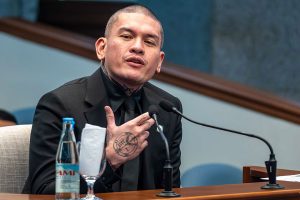
PUBLIC OFFICIALS cannot indefinitely invoke the Arias doctrine to evade responsibility for questionable transactions under their watch, the Palace said on Wednesday, following Davao City Mayor Sebastian Z. Duterte’s testimony before the Senate impeachment court.
Palace Press Officer Clarissa A. Castro said officials may initially rely in good faith on subordinates but should take notice and act when irregularities or other warning signs emerge within their areas of responsibility.
“If you are already seeing anomalies and there are already signs of irregularities, you can no longer use Arias v. Sandiganbayan to cover up your own shortcomings or to protect your ally or your sibling,” Ms. Castro said at a Palace briefing in Filipino.
Her remarks came after Mr. Duterte testified on Tuesday that he was unaware of his sister’s financial interest in GenCorp Industries, Inc., which received contracts from the city government.
The Davao City mayor said his government entered into 19 transactions with GenCorp. He said he would not have allowed the contracts had he known that Vice-President Sara Duterte-Carpio had an interest in the company.
The Vice-President listed GenCorp as a business interest in her 2024 and 2025 statements of assets, liabilities and net worth. Mr. Duterte has maintained that her name, or the Duterte surname, did not appear in the corporate documents submitted by GenCorp for its transactions with the city.
Senator-Judge Panfilo M. Lacson raised the Arias doctrine during his questioning of Mr. Duterte, with the latter saying his lawyers had not advised him about it.
Ms. Castro said the Palace was not making a judgment on the mayor’s testimony but warned against allowing public officials to use lack of knowledge as a blanket defense.
“How long has he been mayor? Considering how long he has been mayor and how he does not look into the contracts he signs, this could become dangerous if other mayors also use this to say, ‘I didn’t know that the person I was transacting with was my sibling,’” she said.
She said the principle should apply to all government leaders, adding that officials must remain alert to transactions within their jurisdiction.
The Supreme Court has held that the Arias doctrine allows heads of offices to rely to a reasonable extent on the good faith and work of their subordinates. But the court has also said the doctrine is not absolute and cannot protect officials when circumstances should have prompted greater scrutiny.
Ms. Castro also called for scrutiny of businessman Jaime Tan Cruz’s corporate links to GenCorp and other companies if evidence warrants an investigation.
“If there are instances that we can say, or can investigate, that a private person is involved in corruption or collusion to steal public funds, we should not stop investigating those kinds of situations,” she said.
Corporate records presented during the impeachment proceedings have identified Mr. Cruz as a representative of JTC Group of Companies Philippines, which was the largest subscriber listed in GenCorp’s incorporation records.
Ms. Castro said the Palace would leave any determination of liability or wrongdoing to the proper authorities, stressing that investigations should proceed when there is sufficient basis.
The impeachment trial is examining allegations under Article II, which questions Ms. Duterte’s declared assets and business interests. The GenCorp transactions have formed part of the prosecution’s presentation on the issue of her alleged unexplained wealth.
NEXT WITNESSThe House prosecution panel is ready to present its next witnesses in Ms. Duterte’s impeachment trial when the Senate impeachment court resumes proceedings on Thursday, although the sequence of the witnesses has yet to be finalized, a prosecutor said Wednesday.
Party-list Rep. James Mark Terry L. Ridon said at a briefing that the one-day cancelation of Wednesday’s hearing for what the Senate impeachment court described as a strategic procedural pause did not affect the prosecution’s preparations for the two-day, whole-day hearings scheduled for Thursday and Friday.
The prosecution is prepared to present Land Registration Authority officials, the Anti-Money Laundering Council (AMLC) Executive Director, and former Senator Antonio F. Trillanes IV as it tackles evidence under the same article.
The panel is also reviewing the order in which the witnesses will testify after senator-judges raised the possibility of hearing the AMLC witness or receiving relevant bank records before Mr. Trillanes discusses matters involving the accounts. The prosecution could adjust to whichever sequence the impeachment court adopts.
Mr. Ridon said the shift to whole-day hearings would give prosecutors enough time to present their witnesses and accommodate cross-examination and questions from senator-judges.
He also said the prosecution was not concerned that a lengthy witness list could make the proceedings difficult for the public to follow, saying the substance of the testimony would be more important than presentation aids.
Meanwhile, a nationwide Momentum Research survey showed that 50.3% of Filipino adults were not following the impeachment trial of Ms. Duterte, while 11.2% were either undecided or declined to answer when asked whether the prosecution or defense was performing better.
The non-commissioned National Momentum Survey, conducted from Aug. 18 to 23 among 1,487 adults, found that 23.3% believed Ms. Duterte’s defense team was performing better than the prosecution, while 15.2% said the prosecution was performing better.
The survey also found that 47.9% of respondents said it was still too early to determine whether Ms. Duterte should be convicted or acquitted. Meanwhile, 24.4% leaned toward conviction, compared with 16% who favored acquittal. — Erika Mae P. Sinaking and Pexcel John Bacon