


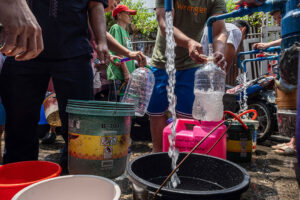
THE PALACE on Thursday cautioned consumers against panic buying and hoarding of water, warning that unnecessary stockpiling could disrupt supplies and push up retail prices amid the impending threat of a super El Niño.
Palace Press Officer Clarissa A. Castro said there is currently no indication of a potable water shortage in the country, assuring the public that government monitoring has revealed no supply deficits. The Palace, however, did not rule out extreme drought conditions or a potential repeat of the 2019 water crisis as global climate impacts escalate.
“We haven’t received information indicating a shortage in our drinking water supply,” Ms. Castro told reporters in Filipino. “It is not advisable to store or hoard water now… Once people hoard, supply could potentially tighten… which will indeed cause water prices to increase.”
The Philippine Atmospheric, Geophysical and Astronomical Services Administration said a strong El Niño is currently active in the Tropical Pacific and is expected to intensify into a “very strong” or “super” El Niño between September and December, potentially bringing hotter temperatures and reduced rainfall in the Philippines through the first half of 2027.
Starting October, the National Water Resources Board is lowering Metro Manila’s water supply allocation to 44 cubic meters per second (cms), down from its regular 50-53 cms range. Ms. Castro urged the public to focus on proper preparation over panic.
Asked whether the government can guarantee that a severe water crunch similar to 2019 will be averted, she said: “We are prepared for that… I cannot say whether or not we will experience extreme drought, but what we really need is to prepare.”
The Palace said the administration has activated Task Force El Niño to coordinate government-wide action covering climate information, agriculture and food security, irrigation, water supply, and social protection. President Ferdinand R. Marcos, Jr. is personally presiding over meetings and directing execution across agencies, Ms. Castro said.
Malacañang appealed to the public to implement household-level water conservation, including repairing plumbing leaks and managing daily consumption.
On food security, the Palace noted that the Department of Agriculture submitted a proposal to Congress on Sept. 29 to expand the minimum access volume for corn to 500,000 metric tons to safeguard livestock feed supply against dry spells, with executive actions set to follow after congressional review. — Erika Mae P. Sinaking