




By Erika Mae P. Sinaking, Reporter
MALACAÑANG said the government has not ruled out adopting a national flood control master plan, even as the Department of Public Works and Highways (DPWH) studies whether river basin-based strategies are better suited to address flooding across the Philippines.
“All the plans that can be used to address the flooding problem can be implemented simultaneously,” Palace Press Officer Clarissa A. Castro told reporters in Filipino on Thursday. “They can be carried out at the same time without causing any issues.”
Her remarks came a day after Public Works Secretary Vivencio “Vince” B. Dizon told lawmakers that the agency does not have a consolidated national flood control and drainage master plan. Instead, the agency has focused on developing plans for major river basins and urban centers.
Mr. Dizon said the approach was partly based on recommendations from the agency’s foreign development partners. The Philippines has 18 major river basins, each with a flood management plan, although 14 are still being updated and are expected to be completed by 2027, based on a DPWH presentation during a House budget hearing.
“The administration is not closing the door on the master plan, however, everything must still be studied to determine what is best for the country and how to better address the flooding problem, especially during periods of extremely heavy rainfall,” Ms. Castro said.
She said the government does not view a national flood control master plan and river basin plans as mutually exclusive and could pursue both approaches simultaneously.
Ms. Castro also cited a flood management master plan developed during the administration of former President Benigno S.C. Aquino III, although she said it appeared not to have been carried over by succeeding administrations.
The National Economic and Development Authority Board approved a P351-billion flood management master plan in 2012 covering Metro Manila and nearby areas. The plan, which was designed to run until 2035, included structural and nonstructural flood mitigation measures, drainage improvements and flood forecasting systems.
The project later evolved into the Metro Manila Flood Management Project, which received funding support from the World Bank, the Asian Infrastructure Investment Bank and the Philippine government.
Ms. Castro said that based on her previous discussions with former DPWH Secretary Manuel M. Bonoan, the department did not receive a copy of the master plan.
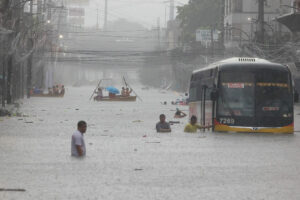
The debate over a national flood control framework comes as large parts of Luzon continue to deal with flooding caused by successive tropical cyclones and enhanced southwest monsoon rains.
31 DEATHSAs of 6 a.m. on Thursday, the National Disaster Risk Reduction and Management Council reported 31 deaths, 19 injuries and three missing people from the combined effects of Tropical Cyclones Luis, Maymay and Neneng and the southwest monsoon.
The weather disturbances affected about 7.7 million people nationwide. Infrastructure damage reached P5.95 billion, while agricultural losses were estimated at P1.91 billion.
The Philippine Atmospheric, Geophysical and Astronomical Services Administration said the southwest monsoon continued to affect Luzon and the western Visayas on Thursday, bringing occasional rains to Zambales and Occidental Mindoro, and scattered rains and thunderstorms to Metro Manila and other parts of Luzon.
The weather bureau warned that moderate to heavy rainfall could trigger flash floods and landslides in vulnerable areas.
Typhoon Saudel remained active west of the Philippines but was outside the Philippine area of responsibility and moving toward the East China Sea, limiting its direct impact on the country.
The Philippines experiences about 20 tropical cyclones annually, with eight or nine typically making landfall.
The DPWH has proposed a P643.95-billion budget for 2027, 21.29% higher than its 2026 allocation, according to the Department of Budget and Management. The budget agency said the increase was partly driven by infrastructure projects that underwent evaluation and validation before being included in the spending program.
The administration has also approved the release of P1 billion for the University of the Philippines System to strengthen Project NOAH’s capabilities, including artificial intelligence applications, real-time hazard monitoring and predictive flood forecasting.
“Of the said funds, P935 million is allocated for research services, while P65 million is designated for project management and administration,” Ms. Castro said.
The funds will also be used to acquire equipment and technology and hire experts for the project, she added.
Flood control spending has also become linked to investigations into irregularities involving government infrastructure projects.
Ms. Castro said Malacañang wants Davao City Rep. Paolo “Pulong” Z. Duterte to submit documents that he said would prove flood control projects implemented during his tenure in Davao City had been completed.
Mr. Duterte earlier disputed Ombudsman Jesus Crispin “Boying” Remulla’s description of Davao City as an “epicenter” of flood control corruption and said investigations should cover projects implemented across different administrations.
Ms. Castro said supporting documents could help determine whether the projects existed beyond their documentary records. She added that Mr. Duterte had been asked by the Independent Commission for Infrastructure to submit documents but had not done so.
“It would have been better if he had submitted it, it would have been helpful, as it would likely show that there has been no dredging in Davao City for 10 years,” she said.