


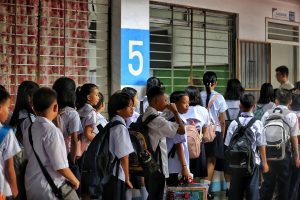


THE Second Congressional Commission on Education (EDCOM II) has called for an overhaul of class suspension rules, warning that broad cancellations of classes are adding to the Philippines’ learning crisis.
In a policy note released on Tuesday, EDCOM II urged the government to amend Executive Order No. 66, series of 2012, to establish science-based criteria for suspending classes during typhoons, flooding, earthquakes, volcanic hazards and extreme heat.
“Decisions must always be data-driven, not based on excessive risk aversion,” authors Tristan Piosang, EDCOM II Executive Director Karol Mark Yee and former Socioeconomic Planning Secretary Karl Kendrick T. Chua said.
Executive Order No. 66, signed in 2012 under former President Benigno S.C. Aquino III, sets rules for canceling or suspending classes and government work because of typhoons, floods and other calamities. It also allows mayors to order suspensions when automatic triggers, such as tropical cyclone wind signals, are absent.
A typical public elementary school lost about 20 teaching days to hazard-related suspensions in school year 2025-2026, or roughly one in every 10 days on the official school calendar, according to the note.
From Aug. 1 to Sept. 15, 2026, 12 of 28 class days were canceled across the National Capital Region and several provinces, equivalent to 43% of class days during the period.
The authors cited a study covering more than 37,000 public elementary schools across two school years, which found that class suspensions were associated with a 0.10-standard-deviation decline in reading attainment. This was equivalent to about 24 teaching days of learning progress, or roughly 1.4 days of reading progress for every suspended school day.
“This means that a suspension does not mean just missing a lesson,” EDCOM II said. “It comes bundled with damaged buildings, interrupted family incomes, teachers coping with their own losses and unsettled children, influences that keep weighing on learning long after doors reopen.”
The problem was less about suspensions themselves than how broadly they are applied.
“What determines which schools close is the jurisdiction line, not purely where the hazard exactly falls,” the authors said.
They cited cases where national or provincial suspension orders covered areas without rainfall warnings from the Philippine Atmospheric, Geophysical and Astronomical Services Administration, resulting in schools being shut “hundreds of kilometers from the hazard that prompted them.”
EDCOM II said 86% of Filipino learners in public schools were not reading at grade level at the start of school year 2026-2027, equivalent to about 4.3 million students.
The commission recommended broadening automatic suspension rules beyond typhoon signals to include heavy rainfall, earthquakes, volcanic hazards and extreme heat, while limiting the discretion of local governments.
It also called for clearer rules allowing mayors and governors to suspend classes across entire localities or only in affected areas, based on scientific evidence and coordination with disaster and education agencies.
School heads should also be given authority to suspend or resume classes based on conditions at their respective schools, EDCOM II said, citing their access to more specific information about local hazards.
“Withholding this would exacerbate our already low educational outcomes,” the authors said.
The commission also recommended that the government compare weather forecasts with actual conditions to improve decisions on class suspensions. — Erika Mae P. Sinaking