




By Mark Joseph M. Sanchez
FORMER President Rodrigo R. Duterte’s first in-person appearance before the International Criminal Court (ICC) does not resolve whether he is fit to stand trial, analysts said, as judges prepare for the Nov. 30 opening of his crimes against humanity trial.
“The legal question is more demanding than whether he can sit in a courtroom,” Ederson DT. Tapia, a political science professor at the University of Makati, told BusinessWorld via Facebook Messenger.
“The chamber must consider whether he can understand the proceedings, communicate with counsel and participate meaningfully in his defense,” he said. “His appearance alone cannot resolve that question.”
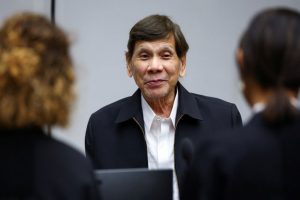
Mr. Duterte appeared before Trial Chamber III on Sept. 16 for its third status conference since his case moved to trial, marking his first physical appearance in an ICC courtroom. His initial appearance in March 2025 was conducted through video link.
A panel of three court-appointed medical experts has submitted reports on Mr. Duterte’s condition. The chamber said in a Sept. 16 decision reviewing his detention that its ruling on his fitness to stand trial remained pending.
The court said the experts’ reports did not contain information that warranted changing the conditions of his detention.
Dennis C. Coronacion, chairman of the University of Santo Tomas Political Science Department, said Mr. Duterte’s appearance carried “profound legal, practical and symbolic significance” while the fitness question remains unresolved.
“First, while the ICC evaluates his fitness to stand trial, his physical presence allows judges to directly observe his demeanor, alertness and physical condition,” he told BusinessWorld via Messenger. “Second, his attendance at the status conference signals that the ICC has shown resoluteness in moving forward with the trial.”
He said Mr. Duterte’s physical appearance could also carry significance for families of people killed during the anti-drug campaign.
“Third, for the victims of the war on drugs, seeing former President Duterte physically inside the Hague courtroom breaks his months-long public nonappearance and serves as a powerful, concrete proof that the international justice system is holding him accountable,” Mr. Coronacion said.
The chamber separately ordered Mr. Duterte to remain detained, citing risks that he could flee or obstruct or endanger the investigation or court proceedings. It said the disclosure of prosecution witnesses and evidence had increased his ability to interfere with witnesses, directly or through family members or supporters in the Philippines.
The detention ruling is separate from the pending determination of his fitness to stand trial.
The Sept. 16 hearing also focused on reducing the length of the prosecution’s case before trial.
Prosecutors have sought 193 hours to present their case, but Presiding Judge Joanna Korner questioned the need for witnesses covering similar subjects and urged prosecutors to consider reducing their witness list.
Mr. Tapia said the chamber could narrow the case while preserving the defense’s ability to examine the evidence.
“The court can focus on the witnesses and evidence most necessary to decide the charges, while allowing adequate time for the defense to examine them and prepare its case,” he said. “If Duterte’s health affects his participation, the chamber can adjust the length or timing of hearings based on medical evidence.”
‘HYBRID APPROACH’Mr. Coronacion said the court could also adjust the trial schedule to accommodate Mr. Duterte’s health.
“The ICC court must use a hybrid approach that streamlines the prosecution’s massive case while actively accommodating the 81-year-old defendant’s health,” he said.
He said the ICC could limit active trial sessions to three to four hours per day or hold hearings on alternating days. This way, the ICC protects Mr. Duterte’s health and gives him ample time to consult with his legal team.
The chamber has already been considering shorter sitting hours and breaks based on recommendations from medical experts. Ms. Korner also said the court needs to conclude the case as quickly as possible, given Mr. Duterte’s age and the medical reports.
The ICC’s Pre-Trial Chamber I confirmed three crimes against humanity charges against Mr. Duterte on April 23 and committed him to trial. The charges concern alleged killings in the Philippines between 2011 and 2019. His trial is scheduled to start on Nov. 30.
Mr. Tapia said the presentation of evidence could shift discussion of the anti-drug campaign away from competing political narratives toward evidence tested in court.
“A trial can move the discussion beyond competing political narratives by putting specific claims, documents and witness accounts to the test,” he said. “Supporters and critics may still interpret what they hear differently.”
Mr. Coronacion said Mr. Duterte’s supporters and political allies could continue to view the proceedings as foreign interference and challenge the credibility of prosecution witnesses.
“For the loyalists and political allies, the ICC trial’s presentation of evidence will likely be viewed through a defensive lens, reinforcing a narrative of foreign interference,” he said.
Mr. Tapia said the proceedings should ultimately establish what the evidence can prove rather than allow public opinion to determine the case.
“The value of the process lies in establishing what the evidence can prove, rather than asking the public to decide the case in advance,” he said.
Mr. Duterte was surrendered to the ICC on March 12, 2025 after his arrest in the Philippines under an ICC warrant. He appeared through video link for his initial appearance two days later.
The chamber has yet to rule on whether Mr. Duterte is fit to stand trial, while preparations continue for the Nov. 30 opening.
“Speed matters, especially for victims and an elderly accused, but a credible judgment depends on proceedings in which he can genuinely exercise his rights,” Mr. Tapia said.